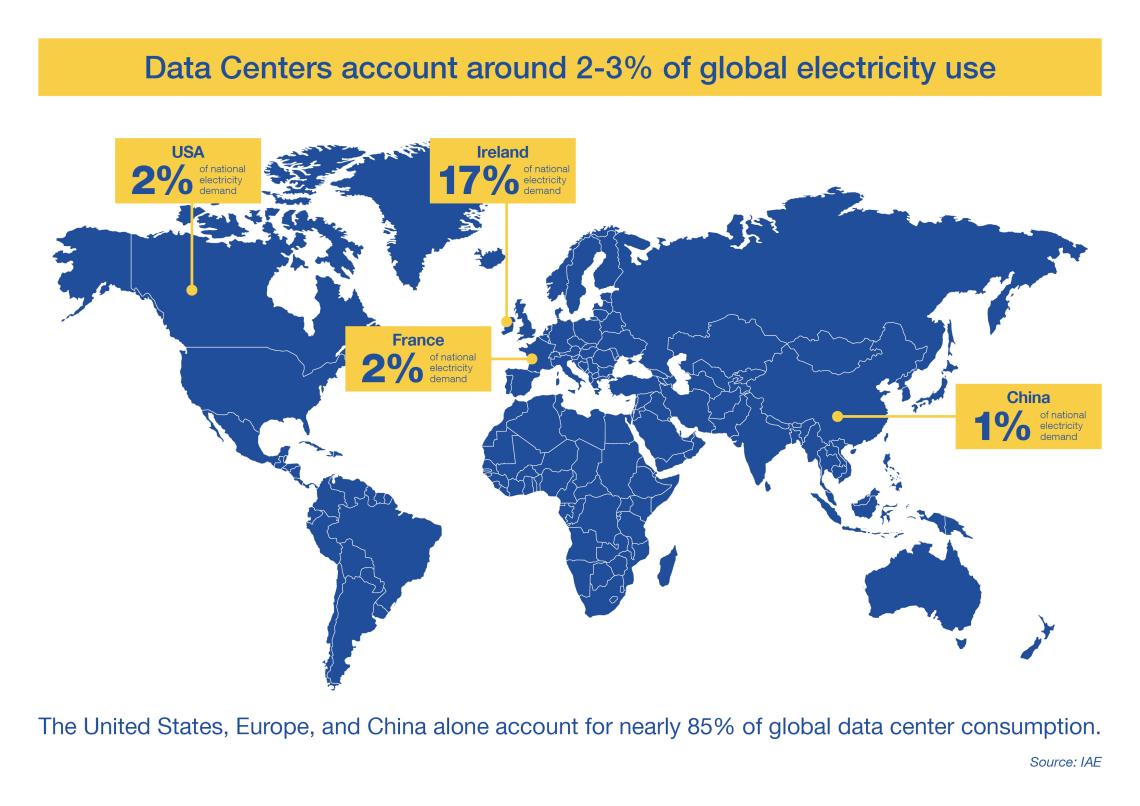
Data Centers are at the heart of today's digital society, powering every search, streamed video, and AI model. As demand for cloud services, artificial intelligence, and digitalization accelerates, so does Data Center power consumption. The International Energy Agency reports that Data Center operations consume around 1–2% of global electricity, with demand expected to triple by 2030 due to energy-intensive AI workloads.
Over the past decade, Battery Energy Storage Systems (BESS) have moved from experimental deployments to mature, grid-interactive assets. Their role is evolving rapidly: no longer limited to emergency backup, they are becoming key enablers of energy flexibility, cost optimization and renewable integration.
This shift marks a broader transformation of the data center energy model. What was once a static and protective infrastructure is becoming dynamic, intelligent, and interconnected with the grid. Operators are under mounting pressure to control energy costs, maintain uptime and meet decarbonization targets in a volatile energy landscape. Electricity can represent up to 40–60% of operational expenses, making smart energy management central to competitiveness.
As a result, power infrastructure itself is transforming — from static protection to dynamic energy intelligence. Facility managers must now guarantee continuity while optimizing efficiency, integrating renewables and supporting grid stability.
Why Energy Storage matters for Data Centers
The growing energy challenge
The scale of energy use in Data Centers is staggering. In the United States alone, Data Centers consume about 2% of the national electricity supply - comparable to the entire aviation industry. Europe is seeing a similar surge, with Ireland’s Data Centre consumption already representing over 17% of national electricity demand.
AI workloads are a key driver. Training large models can consume megawatts per project, while cooling systems often represent 38–40% of total energy use with 24/7 uptime a basic requirement, the strategic priority has shifted: managing energy demand is now as much about economics as engineering.
According to BloombergNEF, the global market for energy storage is expected to grow by more than 25% annually through 2030, driven by sustainability targets, and volatile energy prices. This trend signals that energy storage is no longer niche, it is a core part of the cost-management strategy of modern data centers.
From traditional backup to advanced storage
UPS systems and diesel gensets are becoming largely limited to emergency continuity. UPS batteries typically provide only a few minutes of autonomy - just enough to bridge to generator startup.
BESS takes this further:
- Provides longer-duration energy storage.
- Can charge and discharge flexibly to support daily operations.
- Enables operators to interact with the grid and manage costs dynamically.
In shifting from passive backup to active energy strategy, BESS helps operators turn power infrastructure from a cost liability into a value-creating asset.
Unlocking economic value: optimising energy costs and TCO
For most operators, electricity is their single largest operating expense. Energy storage addresses this financial reality head on by enabling smarter consumption, energy arbitrage and long-term cost control.
Peak shaving and demand response
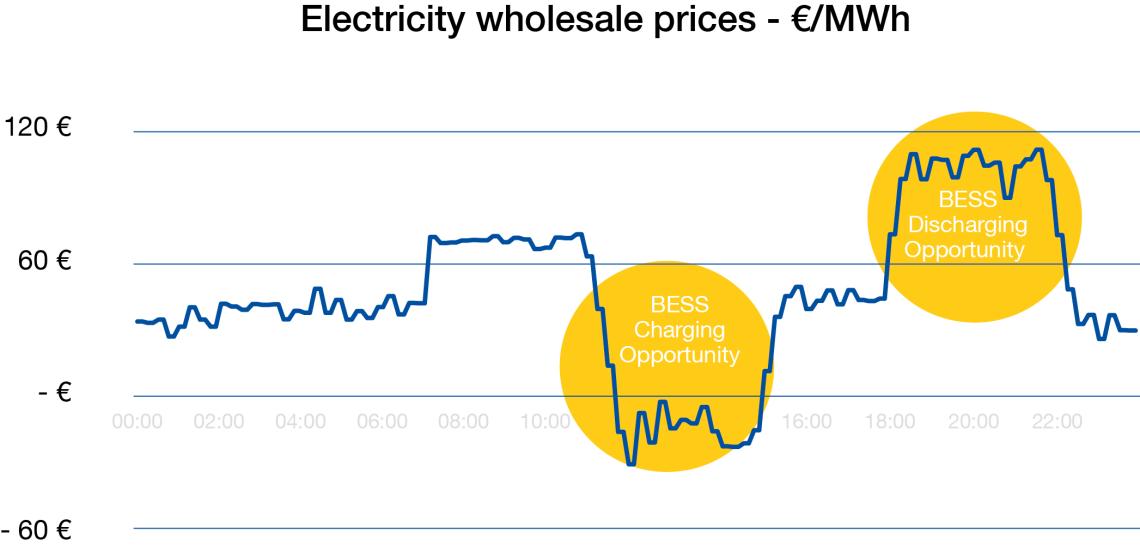
Electricity costs depend not only on consumption but also on when it occurs. Utilities apply high demand charges for peaks, which can make up a significant share of the electricity bill.
BESS helps to:
- Cover peaks with stored energy rather than grid power.
- Optimise use during low-tariff hours and discharge when prices spike.
- Participate in demand-response programs to generate additional revenue.
In mature markets such as the UK, operators participating in flexibility schemes have achieved energy savings of up to 10-15%, while improving overall efficiency.
Extending asset lifespan
By smoothing load profiles, BESS reduces wear on UPS batteries and generators. This minimises maintenance interventions, extends asset lifespan, and reduces the Total Cost of Ownership (TCO).
Depending on configuration, on-site storage can significaly improve autonomy at full load - enough to mitigate transients or delay generator startup during short disruption.
In short, Data Center energy storage turns energy from a cost centre into a controllable, optimisable resource. Beyond cost optimisation, intelligent storage also transforms how facilities operate and maintain critical assets.
Smarter operations and predictive maintenance
As energy storage becomes a core part of Data Centre infrastructure, performance visibility and asset health are becoming new pillars of resilience.
Predictive maintenance approaches, based on real-time data and analytics, now allow operators to detect early warning signs on batteries and power systems, ensuring continuous availability and extending asset lifespan.
By shifting from scheduled maintenance to data-driven supervision, facility managers can optimise both uptime and operational costs. This evolution marks a step toward fully intelligent power infrastructures - where monitoring, analytics, and optimisation work together to sustain performance and efficiency.
The role of BESS in Data Centre resilience
Resilience has always been a defining principle for data centre operations but its meaning is evolving. Battery Energy Storage Systems (BESS) extend resilience beyond simple backup, transforming stored energy into an intelligent, value-generating resource.
Modern storage gives operators the flexibility to actively manage power flows — maintaining uptime while also improving efficiency. Instead of relying solely on generators and static UPS systems, facilities can now use stored energy to anticipate grid events, optimize transitions and secure power quality in real time.
Continuity is no longer reactive; it has become proactive and data-driven — a foundation for smarter, more resilient energy management.
Grid stability and frequency regulation
This new form of resilience extends beyond the facility itself.
By responding within milliseconds, BESS can inject or absorb power to regulate frequency, stabilize voltage, and mitigate renewable intermittency.
Through participation in flexibility markets, data centers are evolving from energy consumers to stabilizing assets within the grid. They can provide ancillary services such as reserve capacity, voltage support, or even black-start capabilities.
In doing so, data centers strengthen both their own reliability and the resilience of the energy system around them, proving that today’s resilience is increasingly about flexibility and cost-efficiency as much as protection.
Partnering renewables with BESS : economic and environmental gains
Sustainability commitments are now standard in the industry. Hyperscale operators such as Google, Microsoft, and AWS have pledged to power their operations with 100% renewable energy. Yet, solar and wind are inherently intermittent.
This is where BESS plays a critical role:
- Store excess renewable electricity when generation exceeds demand for Data Centers.
- Release energy during demand peaks or low renewable output.
- Support a continuous supply of clean power, even when the sun isn’t shining or the wind isn’t blowing.
For colocation operators and large enterprises - who are feeling growing pressure to reduce emissions and meet ESG goals - this can also be a competitive differentiator, enabling them to offer greener services to their customers.
Reducing the carbon footprint of Data Center power consumption
Beyond renewable integration, BESS contributes directly to emissions reduction. By limiting reliance on diesel generators and shifting consumption away from fossil-fuel-heavy grid periods, Data Centers can cut their Scope 2 emissions and meet their sustainability goals.
As energy infrastructure evolves, storage becomes a cornerstone of decarbonization. By stabilizing the grid and enabling greater renewable penetration, data centers actively contribute to the systemic reduction of carbon intensity across the power sector while also managing energy cost trajectories.
Conclusion
Data centers are entering a new era defined by both resilience and sustainability. The traditional approach of relying on backup systems alone is no longer sufficient in a world shaped by digital acceleration and energy volatility.
BESS now plays a central role in this transformation by not only strengthening reliability but by unlocking cost efficiencies and enabling data centers to participate in new energy value streams.
Energy intelligence is becoming the foundation of digital infrastructure, and data centers are evolving from passive consumers into active players within the global energy ecosystem.
Discover more about our approach on the Data Center hub.
Contact an expert
FAQ – Data Center Energy Storage
How much electricity do Data Centers consume?
Globally, Data Centers account for 1–2% of electricity use. In some countries, such as Ireland, the share is already above 15%. With AI growth, global demand could triple by 2030.
Why is battery storage important for Data Centers?
Battery storage enhances resilience, reduces dependence on diesel generators, integrates renewable energy, and lowers operating costs through peak shaving and demand response.
How does energy storage support cooling efficiency?
By flattening energy peaks and enabling smarter load management, storage reduces stress on cooling systems, which improves overall Power Usage Effectiveness (PUE).