
Manual Transfer Switches
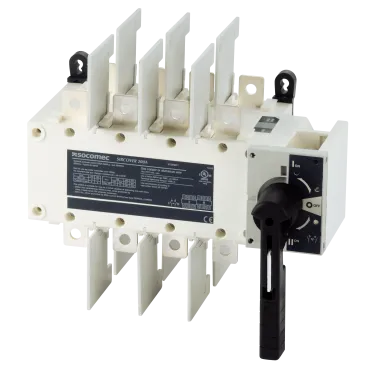
What is a Manual Transfer Switch?
Manual Transfer Switches (MTS) enable the safe and controlled transfer of electrical power between sources, ensuring continuity of supply in situations where backup power is required. In many installations, the ability to manually manage this transfer is sufficient to maintain operations while keeping systems simple and cost-effective.
The operation is entirely manual, meaning that an operator physically actuates a handle to change the position of the switch. This action disconnects the load from the primary source and reconnects it to the secondary source. At the same time, the switch ensures that both sources are never connected together, maintaining full electrical isolation and preventing hazardous back feeding conditions.
This deliberate and visible mode of operation makes manual transfer switches particularly suitable for installations where control, safety, and simplicity are key priorities.
Why Use a Manual Transfer Switch?
Manual transfer switches are especially relevant in applications where automatic switching is not essential and where trained personnel are available to manage the power transition. In such cases, they provide a highly efficient solution that balances operational needs with economic considerations.
By removing the need for automatic control systems, sensors, and programming, these devices reduce system complexity while maintaining a high level of reliability. They are therefore widely used in optional standby systems, where a brief interruption during transfer is acceptable and does not compromise safety or operations.
In addition, manual transfer switches offer flexibility in environments where switching decisions may need to be coordinated with operational procedures, maintenance activities, or generator startup sequences. This level of control can be an advantage in many industrial and commercial contexts.
Key Benefits of Manual Transfer Switches
Simplified and reliable operation
One of the main strengths of manual transfer switches is their inherent simplicity. Based on a purely mechanical operating principle, they do not rely on electronic controllers, sensors, or auxiliary logic to perform switching operations. This straightforward design contributes to long-term reliability and ensures dependable performance even in demanding electrical environments.
Because of their reduced complexity, manual transfer switches are also easier to install, operate, and maintain over time.
Safe source isolation
Safety is a fundamental aspect of transfer switching equipment. SIRCOVER UL manual transfer switches are designed with mechanical interlocking systems that ensure the two power sources can never be connected simultaneously.
This prevents dangerous back feeding conditions that could damage equipment or expose maintenance personnel and utility workers to electrical hazards. Clear switch position indication also allows operators to visually confirm the status of the installation before performing any operation.
Full operator control
Manual transfer switches provide operators with complete control over the power transfer sequence. Since switching is performed intentionally via a handle mechanism, operators can coordinate the transfer with generator startup procedures, maintenance operations, or site-specific operational constraints.
Cost-effective backup power solution
By eliminating the need for automatic controllers and monitoring electronics, manual transfer switches offer a highly economical solution for standby power applications.
Their simpler architecture reduces both initial investment costs and ongoing maintenance requirements, making them especially attractive for installations where automatic transfer switches are not essential.
Robust design for demanding environments
SIRCOVER UL manual transfer switches are designed for reliable operation in a wide range of commercial and industrial applications. Their durable mechanical construction ensures long service life and consistent performance under load transfer conditions.
This robustness makes them well suited for environments where reliability, operational continuity, and equipment durability are critical considerations.
Manual Transfer Switch Range, Standards & Compliance
Socomec’s manual transfer switch offering for the UL market is based on the SIRCOVER UL range, designed for safe and reliable power transfer in low-voltage applications.
Available from 100 A to 1200 A, SIRCOVER UL switches are offered in I‑0‑II configuration, ensuring clear source isolation and safe manual transfer between utility and generator sources. Their robust mechanical design and integrated interlocking mechanism prevent simultaneous connection of sources, ensuring safe and dependable operation.
SIRCOVER UL manual transfer switches are available in versions compliant with UL 1008 for transfer switch applications, as well as versions compliant with UL 98 for switch and disconnect applications. They also support installations designed in accordance with NEC Article 702 for optional standby systems, ensuring high levels of safety, reliability, and regulatory compliance in commercial and industrial environments.
Designed with a focus on robustness and operational clarity, Socomec Manual Transfer Switching Equipment provides a dependable method to switch between a primary source, such as the utility grid, and a secondary source, typically a generator. By combining mechanical reliability with clear operator control, these solutions ensure that power transfer can be performed safely and confidently whenever needed.