Introduction
The most widely adopted model energy codes for commercial buildings are the International Energy Conservation Code (IECC) and the American Society of Heating, Refrigerating and Air-Conditioning Engineers (ASHRAE) 90.1, which are both updated every three years.
As a result, the United States is a patchwork of code adoption, as shown in this status of code adoption map produced by the DOE:
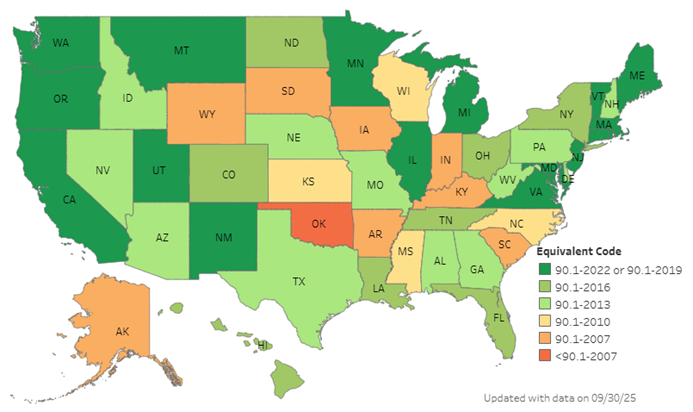
Source: www.energycodes.gov/state-portal
ASHRAE 90.1-2022 as well as IECC 2024 include specific submetering requirements for monitoring energy use across various load categories. While there are nuanced differences between these codes, they share similar objectives: tracking energy consumption by load type in aggregate to enable informed decision-making and targeted efficiency improvements. However, because states often adopt these codes with amendments, the submetering provisions may not always apply.
Submetering requirements of IECC 2024 and ASHRAE 90.1 2022
- Site size
- ASHRAE 90.1-2022 concerns commercial buildings >25,000 square feet.
- The IECC 2024 revision has just lowered thresholds for mandatory submetering implementation in commercial buildings from 25,000 square feet in IECC 2021 revision to 10,000 square feet.
- Load Categories to Submeter
ASHRAE 90.1-2022 and IECC 2024 require the use of meters to collect electrical energy use for each of the following end-use category separately:
|
Load category |
Description |
Required by IECC |
Required by ASHRAE 90.1 |
| Total system |
No |
Yes |
|
| HVAC Systems | Heating cooling and ventilation, including but not limited to fans, pumps, boilers, chillers and water heating. |
Yes |
Yes |
| Interior Lighting | Lighting systems located within the building. |
Yes |
Yes |
| Exterior Lighting | Lighting systems located on the building site but not within the building (example parking lot lighting). |
Yes |
Yes |
| Plug Loads | Devices, appliances and equipment connected to convenience receptacle outlets. |
Yes |
Yes |
| Process Load | Any single load that is not including that is not included in an HVAC, lighting or plug load category and that exceeds 5% of the peak connected load of the whole building, including but not limited to data centers, manufacturing equipment and commercial kitchens. |
Yes |
No |
| Renewable Energy Systems | Solar, wind, or other renewable energy sources must have dedicated meters to track generation and integration with the building’s energy systems. |
Yes |
No |
| Water Heating Systems | Electricity used to generate hot water, for uses other than space conditioning. |
Yes |
No |
| Refrigeration systems | Added in 2022 revision of ASHRAE 90.1 standard when refrigeration exceeds 10% of total building load. |
No |
Yes |
Typical Challenges
Load disaggregation in electrical installations can vary significantly.
Ideally, each load category is isolated upstream in the electrical distribution system, allowing upstream metering to accurately capture kWh consumption per load category.
However, in many cases, upstream feeders supply panelboards serving multiple load categories. When load categories are mixed within the same panelboard, upstream metering lacks the resolution needed for accurate kWh allocation. In this case, granular branch-circuit metering is essential for capturing consumption data for each individual load category.
How Socomec can help
Socomec offers a complete range of metering solutions that support building owners and engineering firms in finding the most effective path towards energy code compliance.
Socomec’s solutions are flexible in their deployment: enclosed power meters can be installed on-site by electrical contractors in existing installations, while loose power meters can be integrated directly inside switchboards, power panels, panelboards during their manufacturing.
|
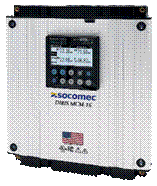
The DIRIS MCM is a multi-circuit enclosed power meter with up to 48 current sensor (CT) inputs, allowing to monitor multiple branch-circuits within a switchboard or panelboard.
A single DIRIS MCM can also be used to monitor circuits in several panels, to lower hardware and installation costs.
The DIRIS MCM is best suited for panels with circuits feeding multiple load categories. |
|
Typical submetering architecture
Below shows a possible submetering architecture to monitor multiple panels sharing multiple load categories:
- DigiBOX A to monitor the consumption of the entire PP1 panel
- DIRIS MCM to monitor the different circuits within panels PP2 – PP6
- DATALOG H80 to collect and store measurement data, and provide a web interface to visualize consumption for each load categories
All power meters and the DATALOG H80 are connected to the local network by Ethernet.
