Automatic Transfer Switches
Automatic Transfer Switches (ATS)
For critical facilities and mission-critical operations, maintaining continuous power is essential. Automatic Transfer Switches (ATS) play a vital role in ensuring electrical continuity by automatically transferring loads between a primary power source and an alternate source during outages or power disturbances. Designed for emergency, legally required, and standby power applications, ATS solutions help protect critical infrastructure, maintain operational uptime, and ensure the safety of personnel and equipment.
As power reliability becomes increasingly important across healthcare facilities, data centers, industrial operations, and commercial buildings, Automatic Transfer Switches have become a key component of modern electrical distribution systems. Discover how automatic transfer switching equipment works, why it is essential for critical applications, and how advanced ATS solutions help ensure safe, reliable, and uninterrupted power availability.
What is an Automatic Transfer Switch?
An Automatic Transfer Switch is an electrical switching device designed to safely transfer power between a normal utility source and an alternate power source, such as a generator or backup power system, without requiring manual intervention like a Manual Transfer Switch (MTS) does.
When the ATS detects a power interruption, voltage issue, or frequency instability from the primary source, it automatically initiates the transfer process to the alternate source. Once normal power conditions are restored, the ATS transfers the load back to the primary source.
Automatic transfer switches are critical for applications where power interruptions cannot be tolerated. By continuously monitoring power quality and responding instantly to outages, ATS solutions help maintain operational continuity and protect sensitive equipment.
Open transition transfer switches are among the most commonly used ATS technologies. These switches safely disconnect from one source before connecting to the other source, ensuring secure transfer operations and protecting electrical systems during switching events.
Why Are Automatic Transfer Switches Important?
Power outages and electrical disturbances can occur even within highly reliable electrical networks. For critical facilities, even brief interruptions can lead to operational downtime, equipment damage, financial losses, or safety risks.
Automatic Transfer Switches are essential because they ensure that critical loads remain powered during utility failures or abnormal power conditions. ATS solutions help facilities maintain continuity, improve electrical reliability, and support compliance with emergency and legally required standby power systems.
Common applications that rely on ATS equipment include:
- Emergency systems
- Healthcare facilities
- Data centers
- Industrial production lines
- Commercial buildings
- Critical infrastructure facilities
By enabling fast and reliable transfers between power sources, ATS solutions help organizations safeguard operations and maintain productivity during unexpected power events.
Advantages of Automatic Transfer Switches
Ensuring Continuous Power Supply
The primary role of an Automatic Transfer Switch is to maintain electrical continuity for critical loads. By automatically transferring to an alternate power source during outages, ATS solutions minimize downtime and ensure that essential systems remain operational.
For facilities where uninterrupted power is critical, such as hospitals, manufacturing sites, and data centers, ATS equipment provides an essential layer of reliability and protection.
Safe Transfer Between Power Sources
Automatic transfer switches are specifically designed to perform safe and reliable source transfers. Open transition transfer switching ensures that one source is disconnected before the alternate source is connected, protecting electrical equipment and preventing unsafe parallel connections between power sources.
Advanced ATS solutions also continuously monitor voltage and frequency conditions to ensure that power quality is suitable before completing a transfer.
Enhanced Safety for Maintenance Personnel
Safety is a critical consideration for any power switching equipment. Modern ATS solutions incorporate advanced safety features that protect operators and maintenance personnel during inspection and servicing procedures.
Features such as protected manual handles, transparent safety covers, and electrical inhibition during maintenance operations help prevent unintended transfers and improve overall operational safety.
These safety systems ensure that maintenance tasks can be performed with greater confidence while reducing operational risks.
Reliable Performance for Critical Applications
Automatic transfer switches designed for emergency and standby systems must deliver reliable performance under demanding conditions. High-performance ATS solutions are engineered to support high short-circuit withstand ratings and critical power applications without derating.
This level of reliability is essential for facilities that cannot tolerate power interruptions or equipment failure during emergency conditions.
Improved Power Quality Protection
An ATS serves as a first level of protection for connected loads by continuously monitoring voltage and frequency conditions. The system ensures that transfers only occur when the alternate source is stable and capable of supporting the load.
This helps protect sensitive equipment from unstable power conditions while ensuring consistent performance across critical systems.
Automatic Transfer Switch Solutions
Modern Automatic Transfer Switch solutions are designed to combine reliability, safety, and ease of operation for critical power applications.
Fully automatic open transition transfer switches are engineered to support emergency (Article 700 of NFPA 70), legally required (Article 701 of NFPA 70), and standby systems (Article 702 of NFPA 70) by safely transferring between normal and alternate power sources without operator intervention.
Key features of advanced open transition ATS solutions include:
- Fast and reliable automatic source transfer
- Continuous monitoring of voltage and frequency conditions
- High short-circuit withstand capability with fuses and specific breakers coordination
- Integrated controllers for intuitive configuration and operation
- Inspectable contacts for simplified maintenance
- Enhanced safety systems for maintenance personnel
- Reliable manual operation capabilities when required
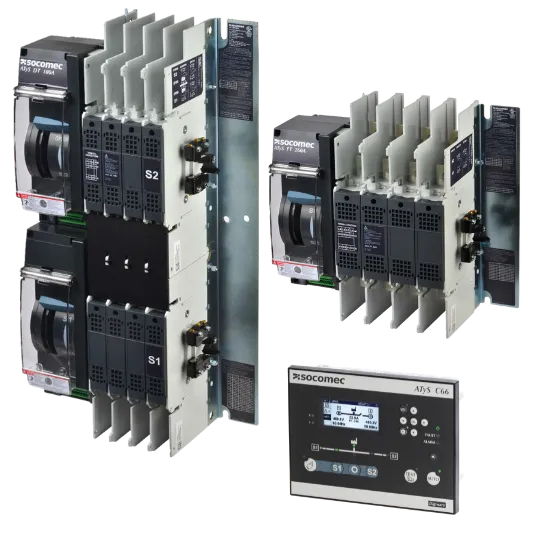
ATyS FT and ATyS DT Automatic Transfer Switches
Socomec, a global expert in power availability and safety, delivers advanced Automatic Transfer Switches (ATS) designed to ensure uninterrupted power for critical infrastructure. As a vital component in modern electrical systems, ATS technology provides seamless switching between power sources, safeguarding operations when outages or disturbances occur.
Serving as the intelligent bridge between a primary power source and an alternate backup supply, automatic transfer switches play a key role in maintaining continuity of service. From healthcare facilities and data centers to industrial operations and emergency systems, ATS solutions provide a simple, reliable answer to complex power reliability challenges.
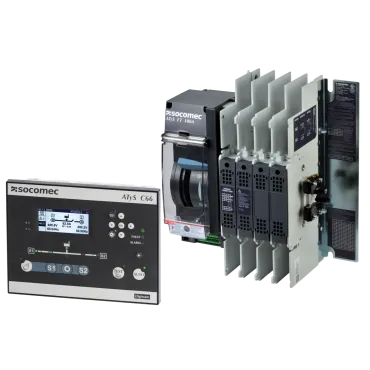
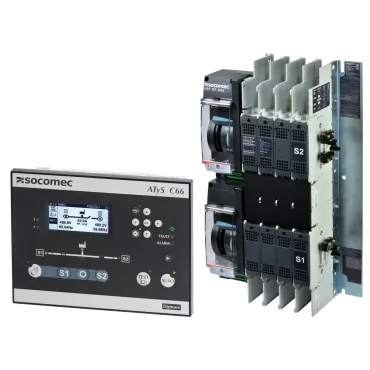
ATyS FT and ATyS DT are fully automatic open transition transfer switches designed for critical standby and emergency power applications.
The ATyS FT is a fast transfer (in-phase transfer) switch without a center-off position, enabling rapid transfer between power sources for applications requiring minimal interruption.
The ATyS DT is a delayed transfer switch with a center-off position, providing full control over the time spent disconnected from both incoming sources during transfer operations.
Both solutions are designed to support emergency systems, legally required standby systems, and critical infrastructure applications while delivering robust performance and advanced operational safety.
Integrated with the ATyS C66 controller, these systems provide intuitive configuration, simplified installation, and continuous monitoring of power conditions to ensure dependable transfer performance.
Advanced maintenance features, including inspectable contacts and protected manual operation systems, help reduce maintenance time while improving operator safety and system reliability.